

The Majesty of The Metropolitan Museum of Art

I love The Metropolitan Museum of Art it’s my second favorite place on earth behind the Chalet. Since I just finished the book All the Beauty in the World I thought I’d share a bit of the history of the institution and a few top reads I feel do a wonderful job offering insight or are just entertaining.

History of the Museum

The Metropolitan Museum of Art's earliest roots date back to 1866 in Paris. Several high-profile Americans residing in Paris put on a Fourth of July festival in celebration of the United States’ ninetieth birthday, with exhibits, performances, and speeches.

The well-known civil rights attorney John Jay II, was the key speaker at the event and his speech noted that New York had become one of the world’s great cities, but it lacked one thing that the great cities of Europe all had - a national institution of art that would represent the essence of American culture; “and thus are the European masterpieces of the olden and present time being rapidly gathered for our country from the Atlantic to the Pacific; and this thought suggests another, that now is the time for the American people to lay the foundation of a National Institute and Gallery of Art, and that the American gentlemen now in Europe are the men to inaugurate that plan” Under Jay's presidency, the Union League Club in New York rallied civic leaders, businessmen, artists, art collectors, and philanthropists to the cause.

On April 13, 1870, The Metropolitan Museum of Art was incorporated, opening to the public in the Dodworth Building at 681 Fifth Avenue. On November 20, 1870 the Museum acquired its first object, a Roman sarcophagus. On March 30, 1880, after a brief move to the Douglas Mansion at 128 West 14th Street, the Museum opened to the public at its current site on Fifth Avenue and 82nd Street. The architects Calvert Vaux and Jacob Wrey Mould designed the initial Ruskinian Gothic structure, the west facade is still visible in the Robert Lehman Wing. The building has since expanded greatly, and the various additions now completely surround the original structure. The Museum's Beaux-Arts Fifth Avenue facade and Great Hall, designed by the architect and founding Museum Trustee Richard Morris Hunt, opened to the public in December 1902.

A comprehensive plan for the Museum by architects Kevin Roche John Dinkeloo and Associates was approved in 1971 and completed in 1991. Among the additions to the Museum as part of the master plan are the Robert Lehman Wing (1975), which houses an extraordinary collection of Old Masters, as well as Impressionist and Post-Impressionist art; The Sackler Wing (1978), which houses the Temple of Dendur; The American Wing (1980), whose diverse collection includes 25 period rooms; The Michael C. Rockefeller Wing (1982) displaying the arts of Africa, Oceania, and the Americas; the Lila Acheson Wallace Wing (1987) of modern and contemporary art; and the Henry R. Kravis Wing (1991) devoted to European sculpture and decorative arts from the Renaissance to the beginning of the 20th century. To view the evolution of the structure click here.

The Museum’s collection has grown from it’s earliest days - the purchase of the Cesnola Collection of Cypriot art works dating from the Bronze Age to the end of the Roman period helped establish The Met's reputation as a major repository of classical antiquities. When the American painter John Kensett died in 1872, 38 of his canvases came to the Museum and in 1889 the Museum acquired two works by Édouard Manet. In 1907, the Museum acquired a work by Auguste Renoir, and in 1910, The Met was the first public institution in the world to acquire a work of art by Henri Matisse. The ancient Egyptian hippopotamus statuette that is now the Museum's unofficial mascot, "William," entered the collection in 1917. Today, virtually all of the Museum's 26,000 ancient Egyptian objects, the largest collection of Egyptian art outside of Cairo, are on display. By 1979, the Museum owned five of the fewer than 35 known paintings by Johannes Vermeer, and now The Met's 2,500 European paintings comprise one of the greatest such collections in the world. The American Wing now houses the world's most comprehensive collection of American paintings, sculpture, and decorative arts.

In 1998, the Arts of Korea gallery opened to the public, completing a major suite of galleries devoted to the arts of Asia. The Ancient Near Eastern Art galleries reopened to the public in 1999 following a renovation. In 2007, several major projects at the south end of the building were completed, most notably the 15-year renovation and reinstallation of the entire suite of Greek and Roman Art galleries. Galleries for Oceanic and Native North American Art also opened in 2007, as well as the new Galleries for Nineteenth and Early Twentieth Century Paintings and Sculpture and the Ruth and Harold D. Uris Center for Education.

Today, tens of thousands of objects are on view at any given time in the Museum's two-million-square-foot building.


Here are some great titles:

The Metropolitan Museum of Art: The History and Legacy of America’s Largest Art Museum - Charles River Editors 8/19/2018

I love this book it is a very small volume packed with details. From the beginning, the Met has been unique, because unlike many European museums, the support for the sprawling New York City museum came from modern tycoons and philanthropists. Like the rest of the city, the museum grew quickly, as the millionaires of New York and other cities around the nation vied to see who could donate the most paintings or objects of art.

From the Mixed-Up Files of Mrs. Basil E. Frankweiler 1/1/1967

The Newberry Medal winner tells the tale of Claudia. When she decided to run away from home planned very carefully and wanting to be comfortable deemed the Metropolitan Museum of Art the perfect place to stay. She saved her money and invited her brother Jamie to come along mostly because he was a miser and would have money. But once the fun of settling in was over, Claudia had two unexpected problems: She felt just the same and she wanted to feel different; and she found a statue at the Museum so beautiful she could not go home until she discovered its maker, a question that baffled the experts, too.

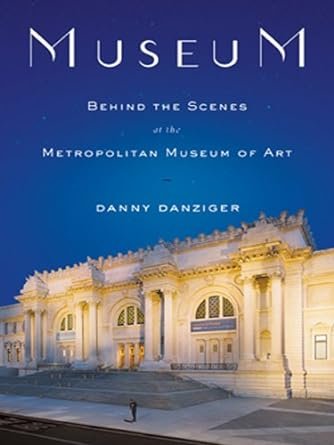
Museum: Behind the Scenes of the Metropolitan Museum of Art 6/21/2007

Using more than fifty interviews, award-winning writer Danny Danziger creates a fascinating mosaic of the people behind New York’s Metropolitan Museum of Art. From the aristocratic, acerbic (now former) director of the museum, Philippe de Montebello, to the curators with deep knowledge and passionate appreciation of the collections, from the security guards to the philanthropists who keep the museums financial life alive and thriving.
The Metropolitan Museum of Art: Masterpiece Paintings 9/13/2016

As the first large survey published in 30 years of the Met's paintings collection it is the first to celebrate the greatest and most iconic paintings of one of the largest, most important, and most beloved museums in the world. This impressive book’s broad sweep of material, all from a single museum, makes it at once a universal history of painting and the ideal introduction to the iconic masterworks of this world-renowned institution.

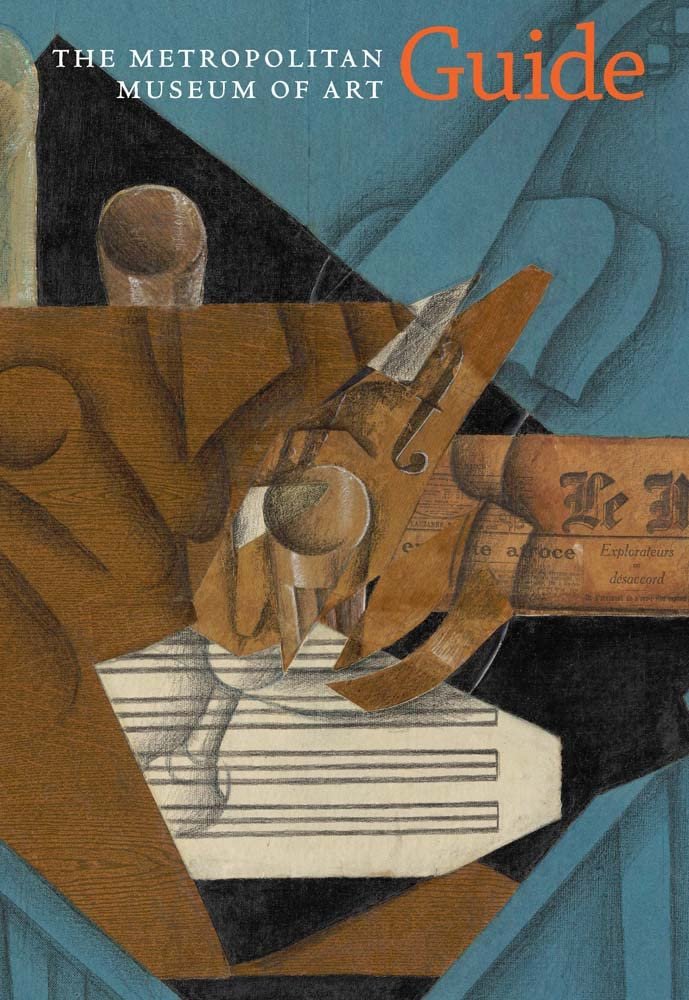
The Metropolitan Museum of Art Guide 6/25/2019

More than a simple souvenir book, The Metropolitan Museum of Art Guide provides a comprehensive view of art history spanning five millennia and the entire globe, beginning with the ancient world and ending in contemporary times.
Metropolitan Stories - Christine Coulson 10/8/2019

Hidden behind the Picassos and Vermeers, the Temple of Dendur and the American Wing, exists another world: the hallways and offices, conservation studios, storerooms, and cafeteria that are home to the museum's devoted and peculiar staff of 2,200 people - along with a few ghosts. A surreal love letter to this private side of the Met, Metropolitan Stories unfolds in a series of amusing and poignant vignettes in which we discover larger-than-life characters, the downside of survival, and the powerful voices of the art itself. The result is a novel bursting with magic, humor, and energetic detail.

Making The Met - 1870 | 2020 The Metropolitan Museum of Art 4/14/2020

Published to celebrate the Museum’s 150th anniversary, Making The Met examines the institution’s evolution from an idea—that art can elevate anyone who has access to it—to one of the most beloved encyclopedic collections in the world. Focusing on key transformational moments, this richly illustrated book provides insight into events that led The Met in new directions, broadened its audience, and expanded its collection. Eleven chapters illuminate topics such as the impact of momentous acquisitions, the global cooperation that resulted from international excavations, the Museum’s association with the “Monuments Men” and its role in preserving cultural heritage during and after the Second World War, and The Met’s interaction with modern and contemporary art and artists. Illustrations include rarely seen archival and behind-the-scenes images, in addition to more than 200 key works that changed the way we look at art.

All the Beauty in the World - Patrick Bringley 2/14/2023

Millions of people climb the grand marble staircase to visit the Metropolitan Museum of Art every year. But only a select few have unrestricted access to every nook and cranny. They’re the guards who roam unobtrusively in dark blue suits, keeping a watchful eye on the two million square foot treasure house. Patrick Bringley finds solace in this institution after the death of his brother and what he thinks will be a temporary job becomes his career of a decade. We follow him as he guards delicate treasures from Egypt to Rome, strolls the labyrinths beneath the galleries, wears out nine pairs of company shoes, and marvels at the beautiful works in his care.

Museum: a building, place, or institution devoted to the acquisition, conservation, study, exhibition, and educational interpretation of objects having scientific, historical, or artistic value.
— The Free Dictionary

Andy Warhol

Camp: Notes on Fashion, 2019 The Metropolitan Museum of Art

Ever since I snapped this image at the exhibit Camp: Notes on Fashion at the Metropolitan Museum of Art in the Summer of 2019 I’ve been thinking of writing about this great American visionary and artist. Since Andy would have celebrated his 95th birthday this past Sunday August 6th I thought this week was the perfect time to share an article about him.

Andy grew up in Pittsburgh, PA. the youngest of four brothers. As a child he suffered from Sydenham Chorea a disease that causes involuntary movements of the extremities. He spent time confined to bed at age 8 and later when speaking about this time said he occupied himself by drawing and listening to the radio; saying this period was very important to his personality development.

I learned through my research Andy won an award Scholastic Art and Writing Award during High School. He attended Carnegie Mellon University in Pittsburgh, where he studied commercial art. While at CMU he joined the Modern Dance Club and Beaux Arts Society. Andy was the art director of the student art magazine: Cano, illustrating a cover in 1948 below: Sprite Heads Playing Violins.

Sprite Heads Playing Violins, 1948

He also illustrated a full-page in 1949 below. These are believed to be his first published art.

Full Page Illustration for Cano, 1949

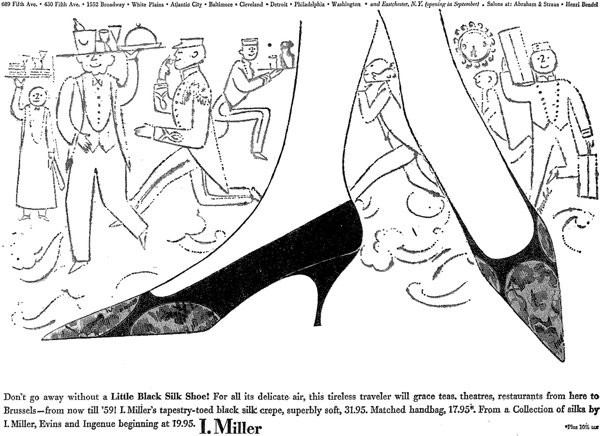
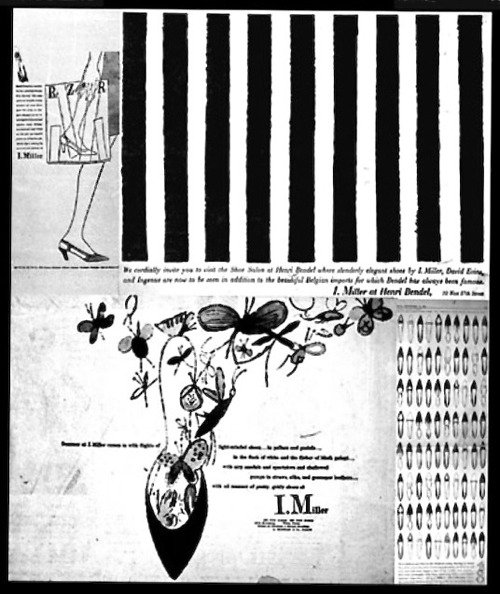
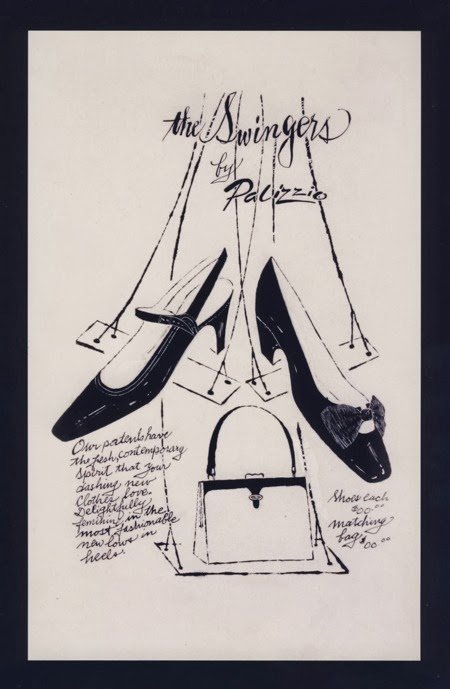
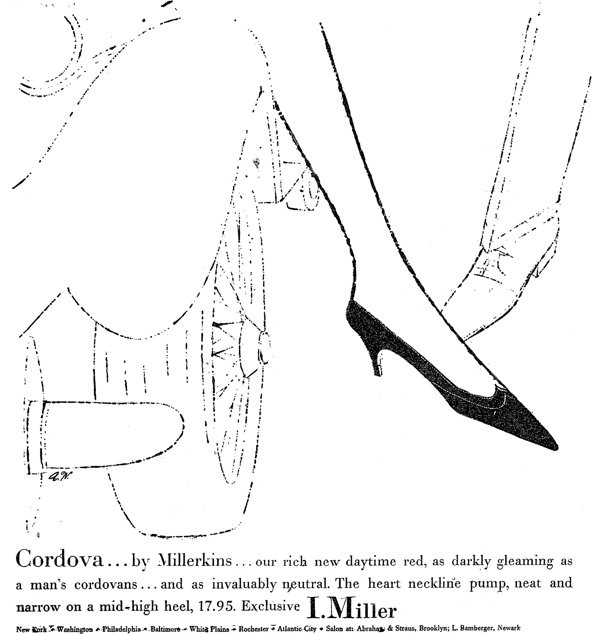
After earning a degree in Pictorial Design in 1949 Andy moved to New York City and began his first career - in magazine illustration and advertising. He drew shoes for Glamour magazine. Andy’s work was well received at Glamour and he was given more and more pages per issue. He was soon working for shoe manufacturer I.Miller. During this time Andy developed his "blotted line" technique, applying ink to paper and then blotting the ink while still wet, which was similar to printmaking. His use of tracing paper and ink allowed him to repeat the basic image and also to create endless variations on a single theme.

Andy had his first solo show at the Hugo Gallery, New York in 1952. In 1956, he was included in his first group exhibition at the Museum of Modern Art, New York. His 1957 his show at the Bodley Gallery, New York included many early ink drawings and some shoe advertisements.

At this time he’s working to pay bills and simultaneously pursuing his art.

By the late 1950’s Andy had started tracing photographs projected with an epidiascope. He used Edward Wallowitch, his boyfriend’s photograph Young Man Smoking a Cigarette (1956) in 1958 for a book jacket design for the Walter Ross novel The Immortal and later used others for a series of paintings.

Andy was hired by RCA Records to design album covers and promotional materials.

In 1962 Andy learned silk screen printmaking and in his book Popism: The Warhol Sixties, Warhol wrote: "When you do something exactly wrong, you always turn up something."

In May 1962, Andy was featured in an article in Time magazine with his painting Big Campbell's Soup Can with Can Opener (Vegetable) (1962). That painting became his first to be shown in a museum when it was exhibited at the Wadsworth Atheneum in Hartford in July 1962. On July 9, 1962, Andy’s exhibition opened at the Ferus Gallery in Los Angeles with Campbell's Soup Cans, marking his West Coast debut. The Gallery, displayed the paintings on shelves running the length of the space, like shelves in a supermarket aisle. “Cans sit on shelves,” Irving Blum one of the gallery owners said later about his installation. “Why not?”

In November 1962, Andy had an exhibition at Eleanor Ward's Stable Gallery in New York. The exhibit included the works Gold Marilyn, eight of the classic "Marilyn" series also named "Flavor Marilyns", Marilyn Diptych, 100 Soup Cans, 100 Coke Bottles, and 100 Dollar Bills. Gold Marilyn, was bought by the architect Philip Johnson and donated to the Museum of Modern Art. At the exhibit, Warhol met poet John Giorno, who would star in Warhol's first film, Sleep (1964).

Gold Marilyn Monroe, 1962

In early 1963, Andy rented his first studio, an old firehouse at 159 East 87th Street. There he created his Elvis series, which included Eight Elvises (1963) and Triple Elvis (1963). These portraits along with a series of Elizabeth Taylor portraits were shown at his second exhibition at the Ferus Gallery in Los Angeles. Later that year, Warhol relocated his studio to East 47th Street, which would turn into The Factory. The Factory became a popular gathering spot for a wide range of artists, celebrities, musicians and writers.

In the spring of 1964 Andy had his second exhibition at the Stable Gallery featuring sculptures. The pieces were wooden boxes with silk-screened graphics consisting of Brillo Box, Del Monte Peach Box, Heinz Tomato Ketchup Box, Kellogg's Cornflakes Box, Campbell's Tomato Juice Box, and Mott's Apple Juice Box. They were stalked and scattered like a warehouse.

A pivotal event was The American Supermarket exhibition at Paul Bianchini's Upper East Side gallery in the fall of 1964. The show presented as a typical supermarket with everything in it created by pop artists. Andy designed a $12 paper shopping bag - plain white with a red Campbell's soup can. His painting of a can of a Campbell's soup cost $1,500 while each autographed can sold for 3 for $18, $6.50 each. The exhibit was one of the first events that shared pop art with the public and asked the question what is art.

The American Supermarket exhibition, Paul Bianchini Gallery, 1964

As an advertisement illustrator Andy has used assistants and this continued in the 1960’s. Gerard Malanga assisted Andy with silkscreens, films, sculpture, and other works at The Factory. He also had a group of individuals whom he entitled “superstars” that worked with him on various projects at The Factory including his films.

In 1967 Andy established Factory Additions for his printmaking and publishing enterprise.

On June 3, 1968, radical feminist writer Valerie Solanas shot Andy and Mario Amaya at The Factory. On the day of the shooting she’d been at The Factory and asked for the return of a script she’d given to Andy. The script could not be located. Solanas had been a marginal figure in the Factory scene. In 1967 she wrote the SCUM Manifesto, a separatist feminist tract that advocated the elimination of men; and appeared in the 1968 Warhol film I,a Man.

Unlike Amaya who had minor injuries and was released from the hospital the same day; Andy was seriously wounded by the attack and barely survived. Two bullets from Solanas’ gun tore through his stomach, liver, spleen, esophagus and both lungs. He was briefly declared dead at one point, but doctors were able to revive him. He spent two months in the hospital recuperating from various surgeries and would be forced to wear a surgical corset for the rest of his life to hold his organs in place.

The shooting had a major impact on his life and work, even beyond the considerable physical scars. He became more guarded and focused on business. In 1969, Andy and John Wilcock founded Interview magazine.

Many feel the shooting contributed to Andy’s early death at age 58. Andy’s intense fear of hospitals led him to delay having gallbladder surgery for years. When Dr. Thorbjarnarson finally operated on February 21 the surgeon found a gallbladder full of gangrene; the organ fell to pieces as he removed it. Andy was also dehydrated and emaciated from having barely eaten in the previous month. Post operation Andy was in his room making calls that evening. He was fine at 4am when his private nurse checked on him. Two hours later he was unresponsive and resuscitation efforts failed. He died of cardiac arrest February 22, 1987.

Warhol had this to say about the attack:

“Before I was shot, I always thought that I was more half-there than all-there—I always suspected that I was watching TV instead of living life. People sometimes say that the way things happen in movies is unreal, but actually it's the way things happen in life that's unreal. The movies make emotions look so strong and real, whereas when things really do happen to you, it's like watching television—you don't feel anything. Right when I was being shot and ever since, I knew that I was watching television. The channels switch, but it's all television.”

published 1975

In 1971 there was a retrospective of his work at the Whitney Museum of American Art. In 1973 he created his portrait of Chinese Communist leader Mao Zedong. In 1975, he published The Philosophy of Andy Warhol. An idea expressed in the book: "Making money is art, and working is art and good business is the best art."

Andy was often at nightclubs in NYC spending a lot of time at Studio 54. In 1977, Warhol was commissioned by art collector Richard Weisman to create Athletes, ten portraits of the leading athletes of the day.

Athletes Series, 1977

Andy dedicated time to finding patrons for portrait commissions including Brigitte Bardot, Mick Jagger, John Lennon, Liza Minnelli, the Shah of Iran Mohammad Reza Pahlavi, his wife Empress Farah Pahlavi, his sister Princess Ashraf Pahlavi and Diana Ross. Reviewers were not kind to his exhibit of portraits calling them superficial and commercial with no depth. In 1979, Andy and longtime friend Stuart Pivar founded the New York Academy of Art.

In the 1980’s Andy gained critical and financial success; partially due to his ventures with younger artists. Jean-Michel Basquiat, Julian Schnabel, David Salle. Andy also earned street credibility when graffiti artist Fab Five Freddy paid homage by painting an entire train with Campbell soup cans. But, there was still criticism that Andy was becoming a business artist. Critics panned his 1980 exhibition Ten Portraits of Jews of the Twentieth Century at the Jewish Museum in Manhattan. In hindsight, however, some critics have come to view Andy’s commerciality as "the most brilliant mirror of our times.”

Andy Warhol, "Self-Portrait", ca. 1982

Andy had an appreciation for Hollywood glamour. He once said: "I love Los Angeles. I love Hollywood. They're so beautiful. Everything's plastic, but I love plastic. I want to be plastic.” Andy occasionally walked the fashion runways and did product endorsements, represented by Zoli Agency and later Ford Models.

from Andy’s Look Book

In 1983 Andy teamed with 15 other artists including David Hockney and Cy Twombly, and contributed a Speed Skater print. The Speed Skater was used for the official 1984 Sarajevo Winter Olympics poster.

Speed Skater, 1983

In 1984, Andy created Orange Prince (1984) when he was commissioned by Vanity Fair Magazine for a portrait to be included in an upcoming article about the musician Prince.

Orange Prince, 1984

In September 1985, Andy’s exhibition with Jean-Michel Basquiat: Paintings opened to negative reviews at the Tony Shafrazi Gallery.

Andy with Jean-Michel Basquiat

Despite Andy’s apprehension later that same month his silkscreen series: Reigning Queens was shown at the Leo Castelli Gallery. The subjects of the 16 pieces were Queen Elizabeth II, Queen Beatrix of the Netherlands, Queen Ntfombi Twala of Swaziland and Queen Margrethe II of Denmark. In the Andy Warhol Diaries, Andy wrote, "They were supposed to be only for Europe—nobody here cares about royalty and it'll be another bad review."

Opening Sequence Andy Warhol’s Fifteen minutes

Andy Warhol's Fifteen Minutes aired on MTV from 1985 to 1987. The five episodes exposed Andy to a whole new audience. I remember watching it.

In January 1987, Andy traveled to Milan for the opening of his last exhibition, Last Supper, at the Palazzo delle Stelline.

On February 17, 1987 Andy and jazz musician Miles Davis modeled at the Koshin Satoh's fashion show at the Tunnel in New York City in a mere 5 days Andy would be dead.

“Someone said that Andy was a skyscraper and when he died the skyline of New York changed,” said Yoko Ono, who described Warhol as the “mentor” of her fatherless son, Sean Lennon. “But it hasn’t changed. Andy is still with us and he will always be.”

I own a print of So Meow. I need to find the perfect stop for it in the Chalet!

So Meow, 1958

I thoroughly enjoyed learning more about Andy Warhol and I hope you did too! Watch THE Andy Warhol DIARIES on Netflix if you haven’t.

Til next time be well and I’ll see you over on Instagram.

All Images Linked. Research: History, Los Angeles Times, The New York Times, Wikipedia.

Artist Focus: Louise J. Bourgeois

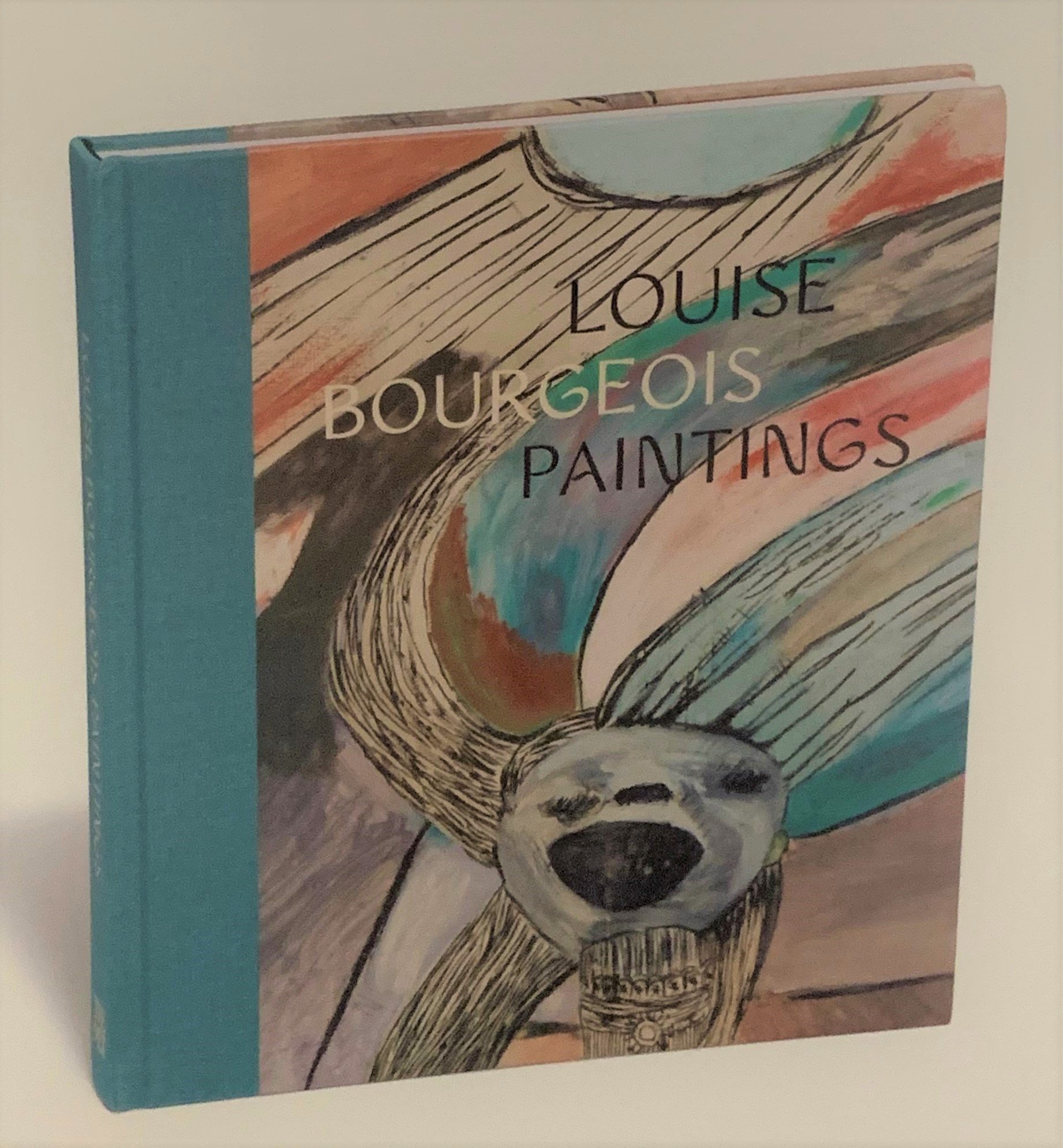
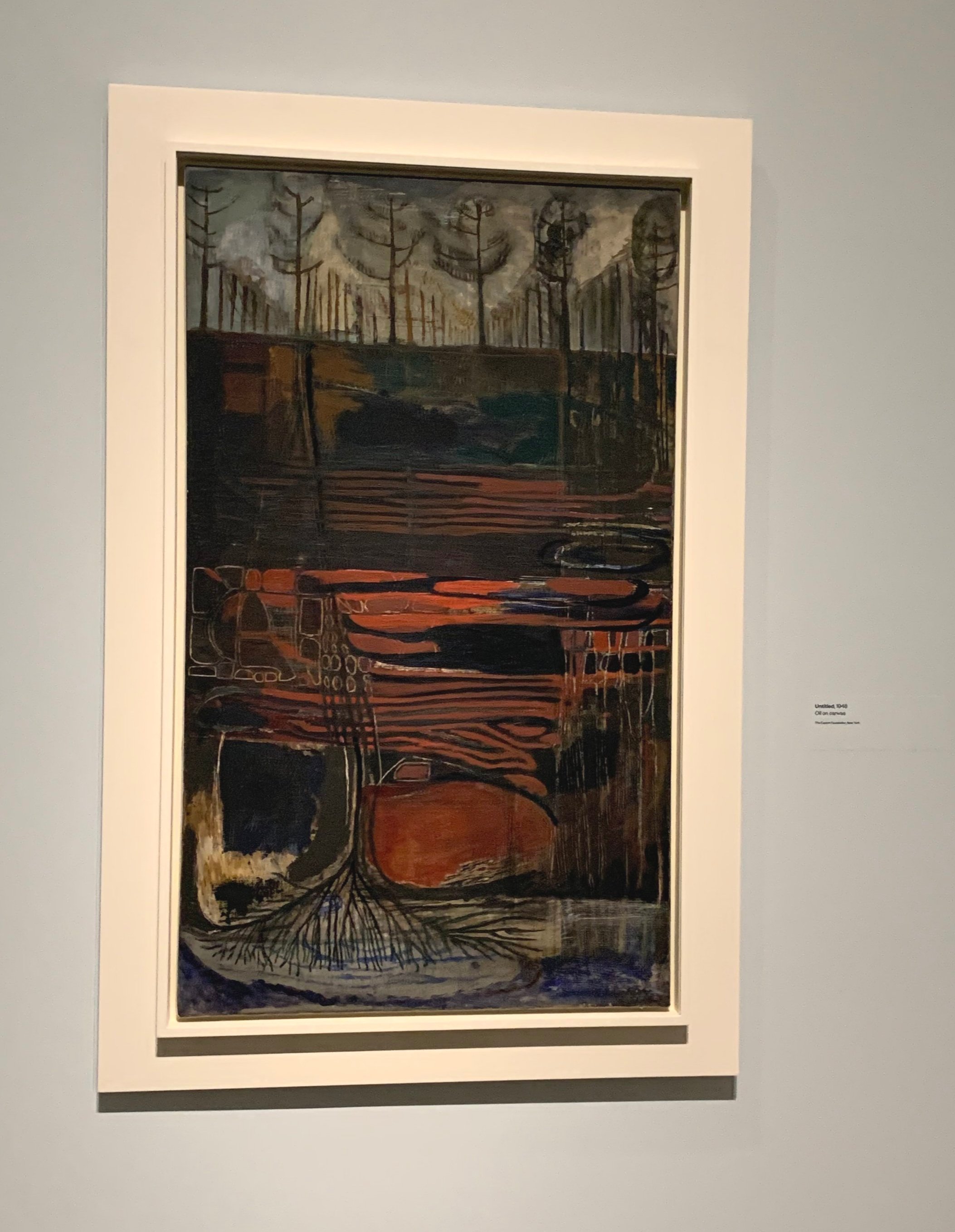
I had the very good fortune of visiting the Metropolitan Museum of Art this past Saturday. While I was there I took in the exhibit of Louise Bourgeois paintings. They were full of unimaginable forms. It closes August 7, 2022 so if you’re able you should pop by this week and head to gallery 913. But if you can’t here are a few images I captured.

I did a bit of research and here’s a brief overview of the artist. Louise Joséphine Bourgeois December 25, 1911 – May 31, 2010 was a French-American artist. Although she is best known for her large-scale sculpture and installation art. She was also a prolific painter and printmaker. She explored many themes over her career including: the body, death, family, feminism and sexuality. Her work is Abstract Expressionism.

Her parents owned a gallery selling antique tapestries - and a workshop for restoration. Louise worked on the tapestries filling in areas of missing design.
In 1930, she entered the La Sorbonne - Université to study mathematics a subject she valued for stability, saying "I got peace of mind, only through the study of rules nobody could change." After her mother passed away in 1932 Louise changed her course of study to art graduating in 1935. Her father thought modern artists were wastrels and refused to support her, so she joined classes where translators were needed for American students and received tuition free. She continued her art study in Paris, first at the École des Beaux-Arts and École du Louvre and in 1938, she opened her own gallery in a space next door to her father’s tapestry gallery where she showed the work of artists such as Eugène Delacroix, Henri Matisse and Suzanne Valadon. This is where she met her husband Robert Goldwater - an American professor who taught at New York University. They settled in New York City and together raised 3 sons. They remained married until Robert’s death in 1973.

Throughout her life she created works finding inspiration from her own life experiences. She held her first solo show in 1945. In 1951 she became an American citizen. In 1954 she became part of the American Abstract Artists Group. At this time she was also friendly with artists Willem de Kooning, Mark Rothko and Jackson Pollock. She has been quoted to say "My work deals with problems that are pre-gender," she wrote. "For example, jealousy is not male or female." With the rise of feminism, her work found a wider audience becoming an icon of the feminist art movement.

In 1973 she started teaching at the Pratt Institute, Cooper Union, Brooklyn College and the New York Studio School of Drawing, Painting and Sculpture. From 1974 - 1977, Bourgeois worked at the School of Visual Arts in New York. She also taught for many years in the public schools in Great Neck, Long Island.

Louise received her first retrospective in 1982 at the Museum of Modern Art in New York City. In 1989 there was another retrospective at Documenta 9 in Kassel, Germany. In 2000 her works were selected to be shown at the opening of the Tate Modern in London. In 2001, she showed at the Hermitage Museum.

She continued to create until her death, her last pieces being finished the week prior to her passing in May 2010.

The very best days are days spent admiring art and artifacts at the Met! I was thrilled to explore galleries I had never visited!

It’s incredibly inspiring to take in new things!

Til next time be well.

Sources: Google, The Guardian and Wikipedia.